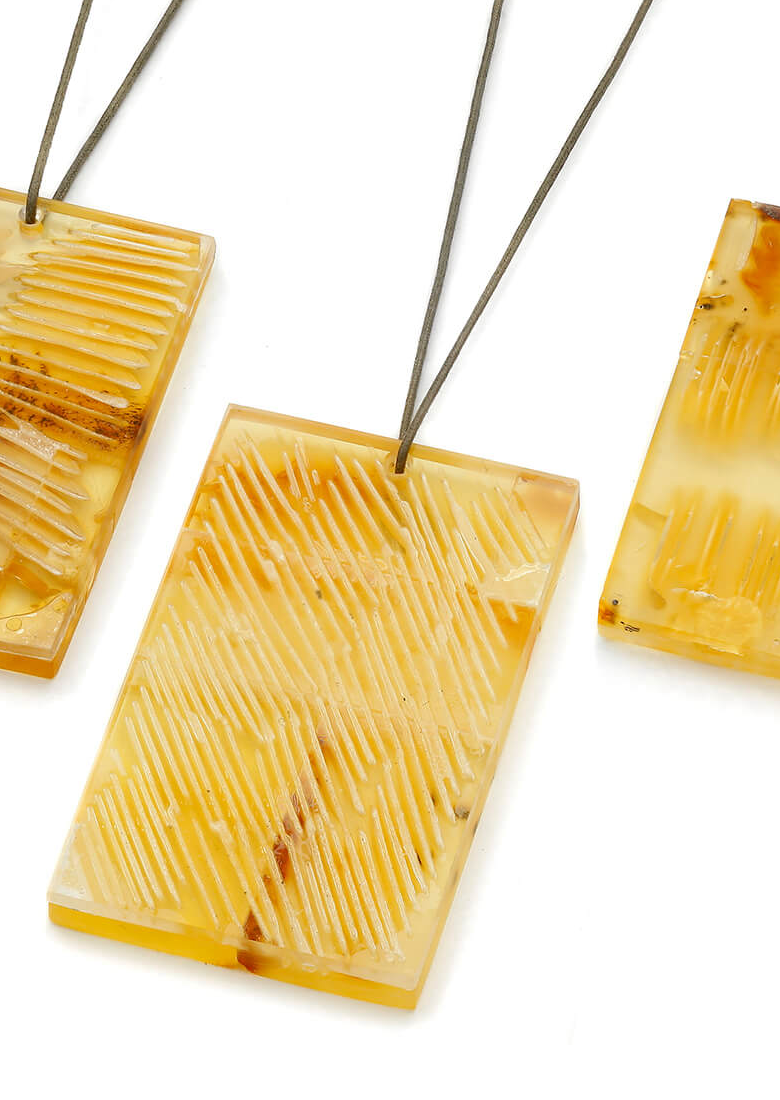
What do we know about Baltic amber? We know where it is found. Its deposits are secondary, of sedimentary origin, and are located in the Gulf of Gdańsk: in Poland and Russia, but also in Germany (Bitterfeld) and Ukraine. We know that it contains succinic acid – between 3 and 8 per cent – which sets it apart from around a hundred other fossil resins. Although it is an acid, it has a beneficial effect on humans: it stimulates, regulates, disinfects and detoxifies.
We know that Baltic amber has a distinctive scent and interesting electrical properties. When rubbed by hand, it smells similar to incense and attracts particles of dry grass and scraps of paper. In this way, it becomes negatively charged, yet in a way that is ‘positive’ and beneficial to humans. Thanks to these characteristics, people have attributed healing and magical properties to it for centuries.
They call it the ‘stone of life’, an amulet that heals, helps and protects. We now know that natural Baltic amber from Gdańsk and the Vistula Delta is distinguished by a remarkable variety of types, a wide range of colours and varying degrees of transparency. It is hardened resin, yet light and brittle. It has acquired these characteristics over millions of years, warmed by the sun’s rays in the dunes, weathered in the sand or compressed by the pressure of a glacier.
No two pieces of amber are alike; each is unique and exceptionally beautiful, with a colour that changes over the years. Thanks to this, Baltic amber has been a prized jewellery material for centuries and is, not without reason, known as ‘precious resin’.